
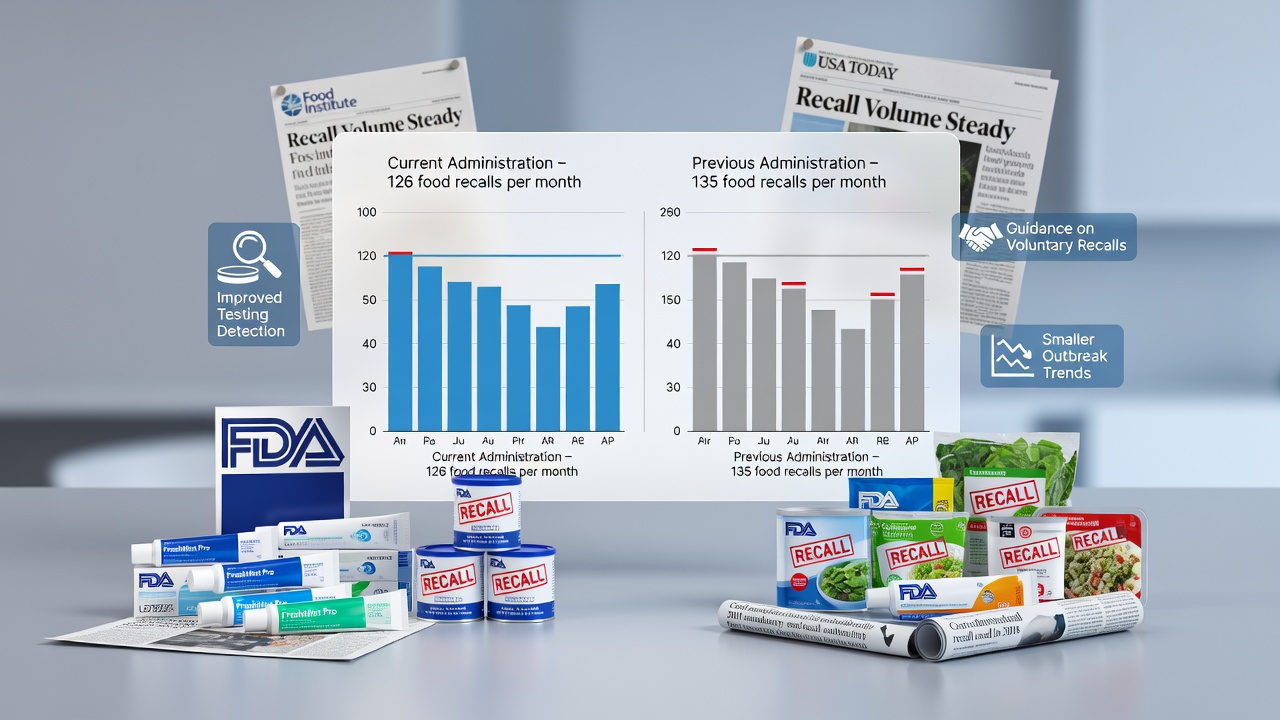
The Food and Drug Administration has issued a steady stream of recalls, including a 4.3 million-tube toothpaste withdrawal with no reported illnesses. Data cited in the source suggest the total number of food recalls has not risen, even though the public perceives more of them. Understanding why requires looking at how the agency uses its authority and how recalls reach the news cycle.
What the numbers show
According to The Food Institute, food recalls in recent months ran about 15 percent below the five-year average. FDA data compiled by USA Today show an average of 126 food recalls per month under the current administration, compared with 135 under the previous one. The source also notes that outbreaks caused by the bacteria responsible for most foodborne illnesses are trending smaller, and better testing now detects illnesses that once went unnoticed. This summer's Cyclospora outbreak was a record and should not be minimized.
Why recalls feel more frequent
Congress gave the FDA mandatory food recall authority in 2011, and the agency first used it in 2018. The source argues that the threat of mandatory action has been enough to shape behavior, because the FDA promised to "won't hesitate to mandate the removal" of products and issued guidance on how companies can recall voluntarily before an order arrives. Recalls also get repeated coverage: the toothpaste withdrawal began in September but drew attention when the FDA classified it in October.
What consumers can do
- Check recall notices for the exact product name, brand, lot code, and size before discarding or keeping an item.
- Remember that a recall of a single product does not necessarily signal a wider risk to its entire food category.
- Pay closer attention to high-stakes categories such as infant formula, where the source reports recalled product still on shelves in more than 175 stores across 36 states.
Limits of the evidence
The figures cited come from secondary sources and cover different measurement periods, so they indicate trends rather than precise totals. The source's broader argument about agency incentives reflects the author's interpretation and is not a finding of the FDA itself. Readers who want to verify recall counts should consult the FDA's published recall database directly.