
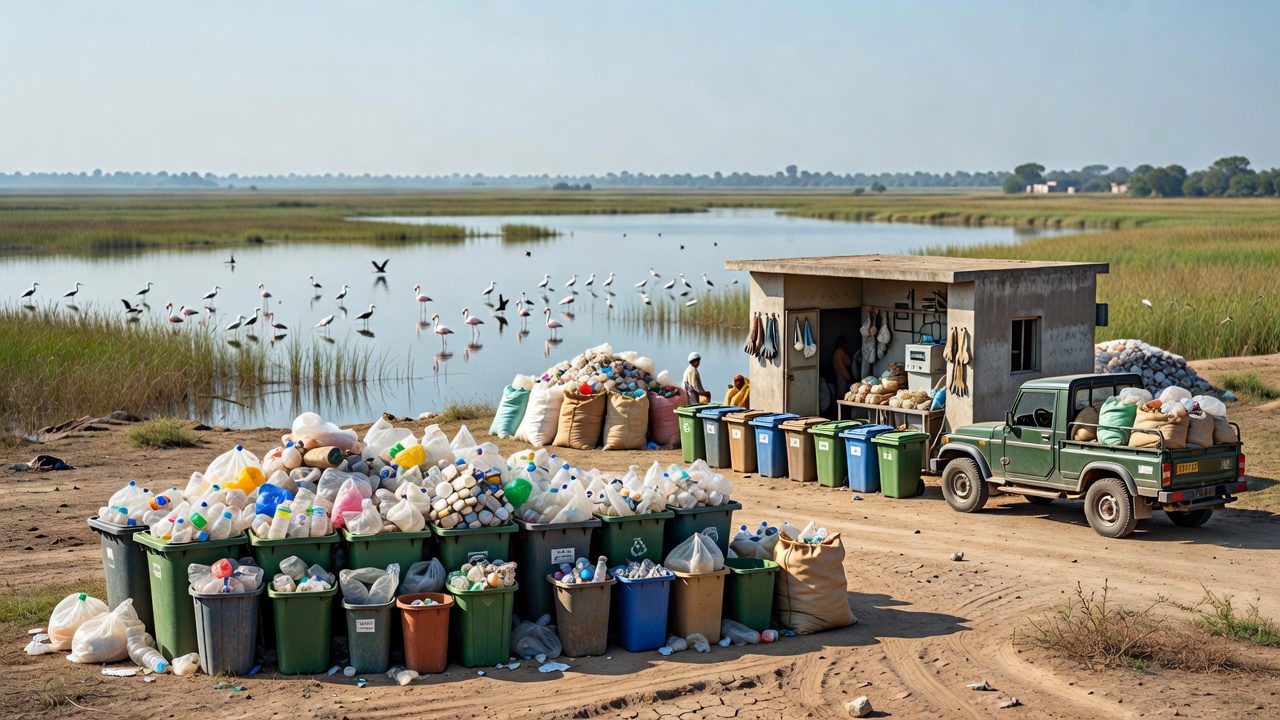
A Forest Department scheme in Gujarat is paying residents of villages around the Nal Sarovar wetland for plastic waste they bring to a central collection centre. The project, supported by Japan International Cooperation Agency (JICA), aims to keep plastic out of the wetland while creating small earning opportunities at the village level.
How the collection system works
There was no formal system for collecting plastic waste in the villages around Nal Sarovar. Under the JICA-supported project, a collection centre has been set up in Kayla village of Viramgam taluka in Ahmedabad district. The facility includes a shed, a processing unit, a compound wall, a security cabin, water and electricity supply, plastic processing machines, safety equipment and waste bins.
The Forest Department has placed 300 large dustbins in each village and about 1,200 smaller bins for households. Villagers can take their plastic to the centre themselves, or the department can collect it using vehicles. The waste is then segregated at the processing unit before further processing. The project covers villages including Vekariya, Kayla, Shahpur, Dharji and Meni in Ahmedabad district, and Nani Kathechi and Ranagadh in Surendranagar district.
Payments and early results
The government pays ₹80 for every kilogram of plastic collected. So far, about 900 kilograms have been gathered under the scheme, which works out to payments of roughly ₹72,000. Local self-help groups have been trained to run the collection work and have received the infrastructure they need. The initiative is still at a preliminary stage, so these figures reflect early activity rather than a long-term track record.
Why the wetland is the focus
Plastic is already banned inside Nal Sarovar for visitors, who must leave plastic bottles in their vehicles at the entry gate. The bigger challenge lies in the surrounding villages, where plastic is in everyday use. Lightweight bags can blow out of bins or wash into the wetland during the monsoon. A public interest litigation pending before the High Court has directed authorities to limit plastic entering the sanctuary, which prompted the collection effort.
Officials say the processed waste is sent to recycling partners, where it may be converted into PET or used in road construction. The department says it is not manufacturing finished products from the collected plastic itself. Officials also say that solid waste management is only one part of the wider JICA project, which includes other livelihood programmes tailored to local needs.